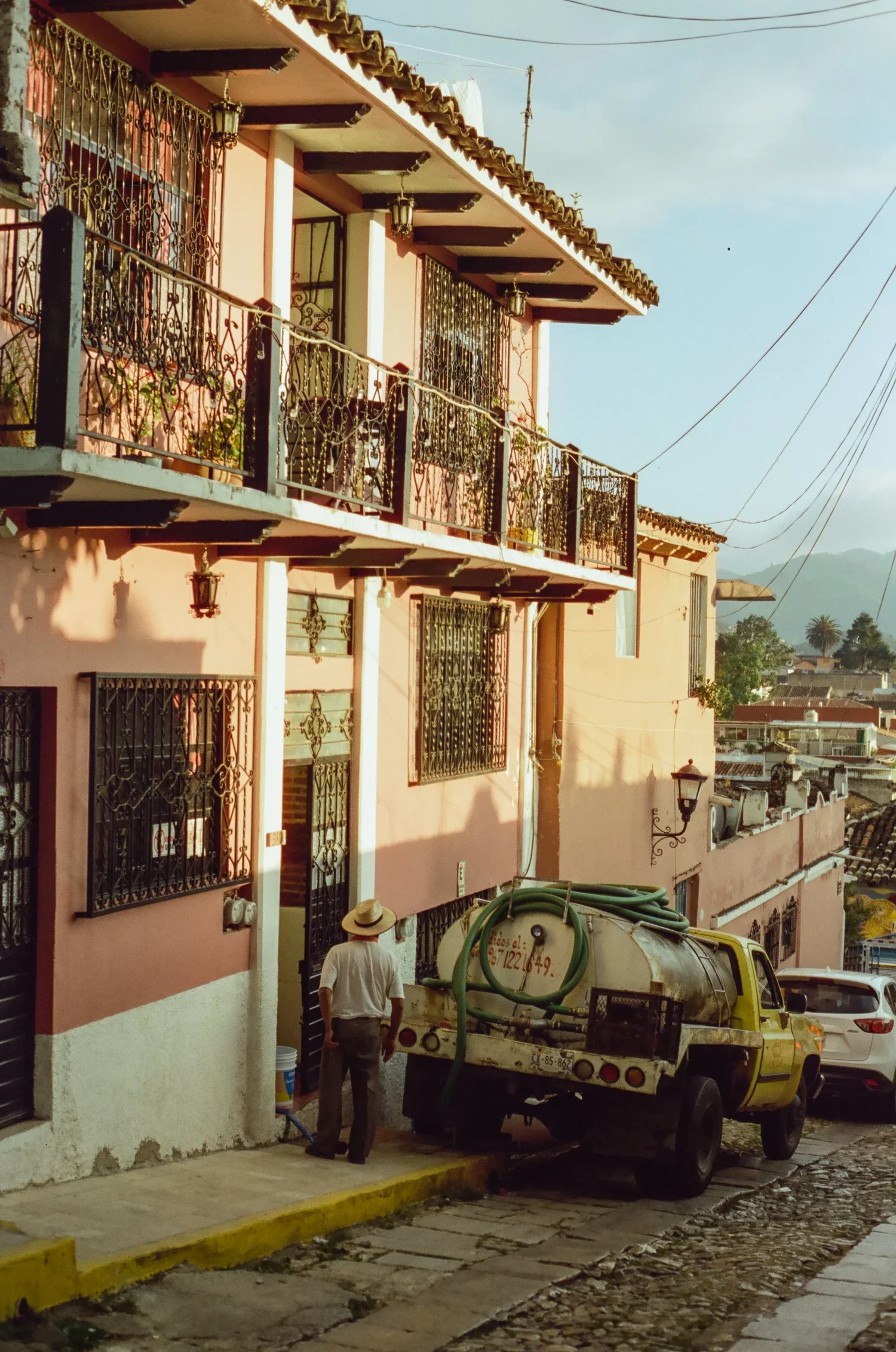
History is built into the streets. Constructed over the ruins of Tenochtitlan, the city layers old stone beside baroque churches, mid-century buildings, and contemporary structures that refuse to erase the past. Walking through it, color, shadow, noise, and time mix together naturally. Luis Barragán’s work brings calm through light and color, UNAM turns architecture into shared space, and the Museo Soumaya curves and mirrors the city back at itself, reflecting sky, traffic, and movement. The art scene follows the same rhythm: folk traditions and contemporary work coexist, murals appear unexpectedly, galleries remain relaxed and unforced. Creativity here does not announce itself; it is woven into daily life.
To fully understand the rhythm, visitors must leave the polished ease of Roma and Condesa and head into Centro. One evening, that means stepping into a cantina near Plaza Garibaldi, where mariachi bands drift in and out, tuning their instruments, waiting to be chosen. Inside, the air is loud and unpretentious—tequila poured without ceremony, songs bought on impulse, strangers drawn into the same moment. It is alive. The city is revealing itself, not for visitors, but to anyone willing to stay long enough to listen.
It is chaotic, yes, but also deeply human. Culture here is not preserved behind glass; it is loud, participatory, and demands attention.
Above all, the people stand out. Mexico City carries a warmth and confidence that does not seek to be noticed. There is an ease in the way residents exist, a quiet assurance increasingly rare elsewhere. Visitors with just enough language to get by are met with warmth; curiosity is welcomed, presence met with presence. The city allows observation, listening, and belonging in motion rather than definition.
In many ways, Mexico City resembles what Los Angeles and New York once were—before edges softened, before creativity became optimized, before everything became performative. Space exists here, both physical and creative, for experimentation, failure, and creation without smoothing for mass appeal. It is raw in the best sense: unfinished, evolving, alive.
No one sees all of Mexico City in one visit. It is too big, too layered, too insistent. But the city leaves a mark. It lingers. Memory surfaces unexpectedly—in the curve of a building, the aroma of street food, the distant hum of music spilling into the night. Mexico City does not ask to be romanticized. It asks only to be experienced—fully, honestly, and beyond the surface. Once it gets under the skin, it does not easily let go.