Mark William Lewis takes LA
The first artist signed to A24 Music, Mark William Lewis stepped into his debut U.S. headline tour last month with the release of his self-titled album, the label’s first musical offering. It arrived at a moment that felt deliberate. As Los Angeles eased into cooler nights, Lewis’s muted, atmospheric sound felt seasonally precise, settling into the city with an unforced ease.
Lewis’s music lives in restraint. Built around a reverberated baritone and minimal arrangements, his songs feel suspended in time — less immediate than remembered. It’s the kind of sound that lingers in the background of long drives or late nights, intimate without asking for attention.
That restraint carried into his live set at Zebulon. Opening the night was Samba Jean-Baptiste, who appeared less like a traditional opener and more like an extension of the room itself. He walked on quietly, guitar in hand, tuning as the crowd continued to settle. The hiss of tall cans opening blended into the atmosphere, unintentional percussion.
With only an acoustic guitar, Jean-Baptiste pulled the room inward. Songs unfolded gently, shifting moods without announcement. “rosewater in process,” an unreleased track circulating only online, landed with particular weight — fragile, unfinished in a way that felt intentional. His set read like a prelude rather than a separation, sketching the emotional terrain Lewis would later expand.
When Lewis took the stage, the energy recalibrated. Tall and shadowed, he carried himself with a reserved, almost bashful presence that contrasted sharply with the softness of his voice. Live, that voice proved even more disarming — delicate, controlled, and quietly commanding.
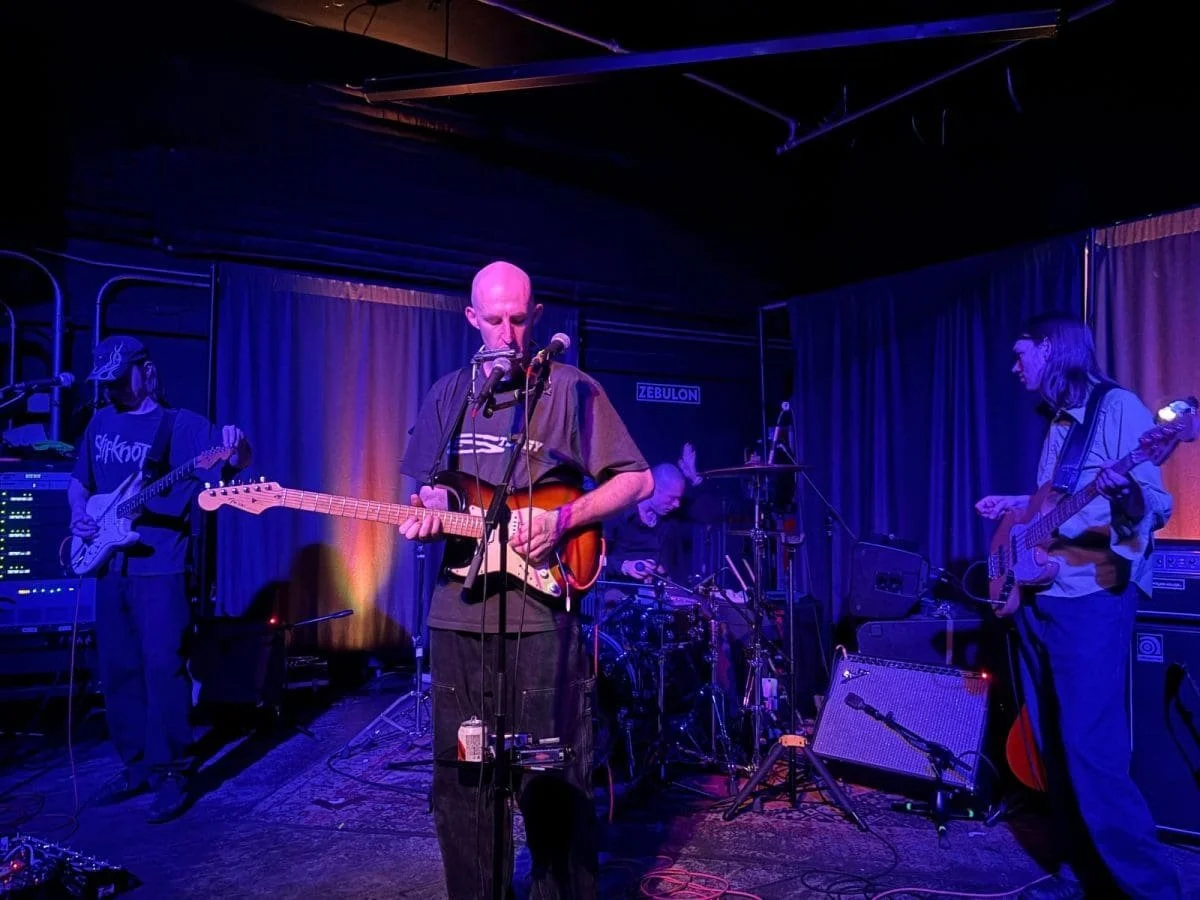
Photo by Ashley Williams
Performing “Cold Paris Vogue” from close range, Lewis moved easily between guitar and harmonica, avoiding theatrics entirely. The effect was subtle but magnetic. The crowd responded not with immediate noise, but with the kind of stillness that follows something fully absorbed.
Between songs, Lewis remained understated, speaking softly to the audience, grounding the set in an unexpected warmth. His lyricism — bruised, introspective — landed heavier in those quieter moments. Even as the band expanded the sound behind him, Lewis maintained a self-contained calm, pausing to credit his bandmates and gently coax the room forward.
By the end of the set, Jean-Baptiste returned to the stage, and the final songs loosened into something communal. The atmosphere shifted from controlled intimacy to something more playful, almost domestic — friends moving together through sound rather than performance.
What lingered most was the contrast. Someone so visually severe creating something so tender. The softness ultimately won, trailing the audience out into the night — unspoken, intact.
